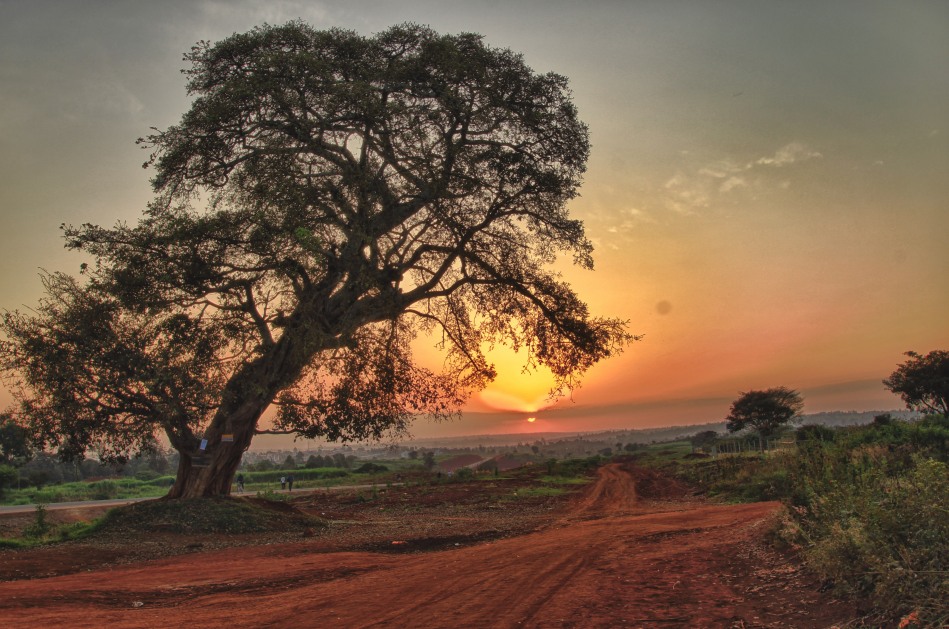
Mugumo is the name of a special sacred tree known to the Kikuyu community and many others in Kenya. Its name was inherited from the ancestors, and the ancestors inherited it from their ancestors.
For some reason, the holiness of this tree has survived the ages. Even a cultural invasion by foreigners -which Mugo Wa Kibiro prophesied about and influenced the dress code of the natives and gave them a foreign language- didn’t destroy the sacredness of the Mugumo tree. Several theories have evolved about this indigenous tree.
Some natives believe that going around this tree seven times would automatically change one’s sex. But no one has ever experienced this transformation. Others believe spirits of the ancestors and the living dead hover around this tree. In fact some have claimed to have heard and recognized voices of departed relatives.
Mugumo is a rare tree found only in big forests like Mount Kenya. The Kikuyu community inhabiting the slopes of mount Kirinyaga, which has since been renamed Mount Kenya, considers this tree their shrine. They use it to commemorate their land’s independence.
All in all, it holds significant memories. Memories acquired by a long life span that has outlived many ancestors. The Mugumo tree, having survived centuries, makes it the only existing tomb for the ancient heroes of this land. Maybe their spirits too are hovering around it giving the tree its sacred importance and hence its special cultural importance.
It’s under this tree that Mugo wa Kibiro prophesied and made his home. He prophesied for many years. He never at any time prophesied that one would suffer poverty if one didn’t pay their tithes, as our now adopted religion professes. Neither did he prophesy riches if you give freely, but he did prophesy about the cultural influences of modernized foreigners that would come to Kenya long after he would be joined with his ancestors.
In a vision, he saw a long snake that was moving from the seacoast toward the land of kirinyaga. At intervals it stopped to vomit and swallow beautiful pale butterflies.
The natives had been fascinated by the butterflies and as they admired them, tried to not only to understand them, but also copy their ways of dressing.
Women saw how they could conceal their bare chests with blouses and replace the lesos wrapped around their waists with skirts. The men wore trousers and shirts. They learned from these butterflies that it was evil to be nude, hence giving them a chance to move onto another stage of development. By the time the people of kirinyaga realized their mistakes of admiring the butterflies it was too late. The larvae had already formed and the number of butterflies increased so much that all they could do was watch. And all that they had inherited from their ancestors disappeared and they were left with nothing. But not completely nothing; they learned and adopted a new language.
Mugo wa Kibiro, despite being a great prophet could not comprehend the vision, but he had one role; to pass it to the people. He rose before the birds started their morning glory and held his horn over his mouth and passed his message to the whole village.
The people of Kirinyaga woke up amazed. They had heard many prophecies but this one was strange and for some reason scary. Yet their prophet could not interpret the vision. They believed him however and they waited and waited even after Mugo wa Kibiro had peacefully joined the ancestors of the land. The prophecy was passed on to their children, who grew up and passed it on to their children, who had also passed it on to their children and on it went.
Decades passed before the butterflies started arriving and lost in confusion the natives did not realize that it was only the beginning of things to come. At first just a few butterflies explored and tried to discover the parts of Kirinyaga, which produced the juiciest flowers.
Then the torch bearers who claimed to have seen the sunlight better than anybody and in fact had a chance to also touch the son of the sun, surprised the natives by their willingness to share their secrets of how to reach the son of the sun which could replace the dim moonlight of the land. For sure the land became brighter. The snake passage was constructed which before long was used for journeys from the seacoast to Kirinyaga and back, while stopping at several stations to vomit its occupants and swallow more as well.
Symbols of his vision: Snake is a train. Torchbearers are Christian missionaries and butterflies are the white foreigners
The natives had been consumed with fear when they realized the honeymoon period was over. A whip was used when anybody tried to go beyond the Mugumo tree, which was out of bounds to him and his likes. Some areas were reserved for the butterflies and for their protection the natives were forbidden access to these places.
It was then that they recalled that their forefathers warned them to be wary of the butterflies. Still they kept waiting for the butterflies without thinking beyond. How naive!
The land of Kirinyaga, which had once been filled with the presence of nature, had undergone a transformation, except the Mugumo tree. Its nature wasn’t altered in any way, perhaps due to the living spirits of the ancestors.
The beautiful thatched huts with bulrushes that were plastered with red and white clay had been replaced with houses built with timber or stones and roofed with iron sheets.
The religion of the natives was to kneel down while facing Mount Kirinyaga where their god Ngai dwelt. Ngai was their provider of rain, food, children and divine health. He would respond to them through thunder, lightening or wind. This religion underwent a metamorphic process. In fact evidence of this religion was completely erased.
The natives would now rise at dawn and holding a cross fixed to a small chain that was donated through the generosity of the holy father, would recite prayers. They of coarse had no knowledge as to why they were holding a cross. Neither did they understand a word they recited for they only followed what they were taught.
Their original lifestyle had not been spared by these changes. The young ones went to school to be taught that it’s evil to steal, cheat, kill, disobey others and that righteousness is to love, to give abundantly, to obey and to respect others.
But did the foreign teachers who taught them these things lead by example?
The picture for this story was used with the courtesy of <a href=”http://www.bushveld.co.za/”>http://www.bushveld.co.za/</a>.
Related
Nice article about the Mugumo but very inaccurate. e.g that the tree grows only in the forest of Mt Kenya.
could send you one chapter of my research primarily on the Mugumo and the Gikuyu cosmology and worship. do contact me.Karangi phD
Dr. Karangi, I would like to see your research on the Mugumo tree. I am looking at human evolution and I am very interested in the role this tree may have played. My email is donaldpanhorst@gmail.com. Thank you.
Intreasting Dr Karangi-please send me your said artical on mugumo tree and Gikuyu cosmology.
Yed you right Mugumo can grow beyond Mt Kenya…kimbu has countless of them.
Dr.Karanja,
I do agree with you about the mugumo tree growing only in mt Kenya since I grew up close to one in Kiambu. I am Intrested to have a painting of the Mugumo tree. i live in CA and I have an artist who can paint the tree that was my first worldly fears in to a beautiful painting. Please send my any pictures you might have for this tree.
Thank you,
Grace Koinange
Its not true that it only grows near mount kenya. My mother chopped one down in Ngong.
Dear Dr. Karangi,
I read your comments regarding the mugumo tree with great interest. I am working on my Masters’ Thesis and i’m doing research on the relationship between colonialisation and environmental degradation in sub-Saharan Africa with a focus on Kenya and a francophone country. I would be interested in reading your published work on the subject of Gikuyu cosmology and worship.
Looking forward to hearing from you,
Sincerely,
Wanjiru
Dr. Karangi,
I’m an educator interested in the history of the peoples of Africa. I’m currently researching the peoples of East Africa, particularly Kenya and would like to be able to pass on information that is as accurate as possible. I would be very interested in reading your research on the Mugumo and Gikuyu Cosmology. If you could share it with me I’d be very appreciative. I’m particularly interested in the effect of spirit mediums on the liberation struggles of the present day Kenyans. I’ve come in contact with some information on Dedan Kimathi, Nyabingi, Muhumusa and Mekatilili wa Menza and am interested in more detailed information on all of the above heros and heroines of the liberation struggle, as well as others not mentioned above.
Thanks for your assistance.
Hi
I would like to read Dr Karangi’s paper too…. Please email mikeshanahan@yahoo.com
Mike
Dear SZ,
We are in the process of starting a tree magazine in Kenya calle MITI.
MITI is a new, high quality and full colour Tree business magazine, the first of its kind in East Africa.
The aim of this magazine is to inform and entertain all, professional or not with articles about or related to afforestation in Africa.
Miti is targeted at tree lovers, business people, farmers, ecologists, scientists, investors, students, N.G.O.’s, government policy makers and all readers at large who wish to know how important afforestation is for the present and future generations. The articles and the magazine as a whole will be tailored in such a way as to greatly interest the general readership in East Africa.
Each issue will have recurrent departments aimed at enlighten its readers to the challenges and rewards related to tree planting in Africa. Apart from business articles and news updates related to afforestation Miti will also give information on controversial tree issues, the historical use of trees, water management, tissue culture etc.
Miti will run interviews of farmers or individuals and companies with a successful afforestation story so that the readers may benefit from their experiences.
The magazine will tackles issues like improving techniques and give out advice to its readers as local institutions will have the occasion to present themselves and their work in EA as well.
Miti is published in Kenya and aims to print 3000 copies for Uganda and Kenya today. 2000 copies are earmarked as corporate complimentary issues.
Miti is not just a magazine; it is more like a continuous positive training program, on how people can become better through tree planting, in both business and life in general.
After being told stories related to the fig tree by local people we searched the internet to find out more information and found this most interresting article called “The Mugumo Fig Tree of Kenya” written by Elizabeth Mumbi Waichinga.
We herewith seek your formal authorisation to publish the article in our newly magazine with mentioning of the source.
Please find here under my full coordinates.
Hoping for a positive reaction we remain
Yours truly
Jean-Paul Deprins
Managing Director
Better Globe Forestry Ltd.
P.O.Box 823-00606
Nairobi, Kenya
Tel: +254 20 4343435 / 3594200
Mob: +254 722 262061
E-mail: jpd@betterglobeforestry.com
http://www.betterglobegroup.com
If you want to feel good, do something for others http://www.childafrica.org
Hi, am Kenyan greatly interested about the mugumo tree. Kindly if tell me and others who might be harbouring the same, if the mugumo does flower and if, when and what is the colour of the flowers. Thanks
I would like to get in touch with Dr. Karangi, kindly email me- elizabeth@edumedtrustkenya.org
I am a very good follower of Kenyan history, and some times people thing I am Kenyan but a Malawian. I sometimes feel bad when I read that Dedan Kimathi was killed by a fellow black man. I have got so may questions than answers, who was the name of this soldier? Are his children enjoying the freedom the Kenyans are enjoying to-day. I nearly wept when I saw Dedan Kimathi in the middle of Nairobi.
True, Mugumo tree is found around Kenya Mountain, still other places might also have them but abundantly they are around Kenya Mountain.
I would like to read Dr Karangi’s paper too…. Please email matimu76@yahoo.com
Mugumo was a fiction story – ofcoarse it was based on stories i heard as a child but it was submitted under fiction. I wrote this story when i was much young and its exciting to see comments realting to the subject 6years later. Hope szirine will once give an interactive forum- Culture is interesting. Isn’t it?
Great article! I learned a lot.
I live in Kenya, Diani Beach. We have six acres lush-tropical garden and Mugumo three is one of our pride.
sorry guys, I have just come across this site. Any one interested with the Sacred Mugumo tree can read my published article or ask me to email them a copy.
Thanks. you can reach me on this email address. matthewkarangi@yahoo.co.uk
Thanks
Dr. Karangi
Hello Dr Karangi. interesting piece on the mugumo tree. I am a student at a kenyan univeristy doing a project on kikuyu foods and drinks. Is their any information you could help me with?
what a relief to knw more about our secret shine tree will all due respect thanks 4 highlighting about our divine tree kudos n live long mugo wa kibiro
What a relief 2 knw abot our shrine divine tree thanks man and live long mugo wa kibiro
Mugumo tree is a tree which grows well in high altitude, but it has also be sited in rocky dry areas. It is a popular tree in Kikuyu land because it was considered to be holly.
Haha@M.K Live long Mugo wa Kibiro?
Thanks all for comments- i hope someone will spearhead a discussion of cultural issues – its clear there quite a bit of interest there. Dr. Karangi, thanks for comment.
Yes, the fig tree is the most sacred plant among Kalenjins also. Fig tree abound in Bungoma district. What is amazing is that there are only about five fig trees in the entire Rift Valley one of which is in my farm. I always thank God for it.
I am very interested in your tree. I am a biochemist from the United States and I study how I believe the Mugumo tree drove human evolution. I believe there is much truth in ancient African religions. I am not a religious person, but if I where, I would follow the Kikuyu.
want to know more about mugo wa kibiru his [pprophecy on presidency n mugumo tree
Mugumo wa Giakanja has finally gone to sleep.The ancestors have spoken again. Its time for ituika (political change of the government). The last ituika took place in 1935 in most of the Gikuyu land. Ituika usually occurred every 30 to 40 years. If we can recall the history, when Jommo Kenyatta took over the government it was the time for utuika. Kibaki was the next to embrace the next ituika. Remember Moi does not qualify. The Mugumo wa Giakanja has now spoken, whether you believe in the traditional Gikuyu religion or politics or not, the time for ituika has come and either Mwangi or irungu are about to take over. It can also be the fact that we are getting a stern warning from ngoma(ancestors-aria makomire tene) that the Gikuyu religio-political power is waning, at least for a while until the next ituika.
Whether it is Uhuru or somebody else, whether it is the new generation about to take over the religio-political power from the old generation or whether it merely a religio-political change (a surprise) about to happen, lets wait and see. Mugumo wa Giakanja is not for the Nyeri Gikuyu only but for the whole Gikuyu people. This is not just about Kibaki leaving power, but rather about the Gikuyu as a people. Their religio-political power is being threatened and if they are not careful, they might have to wait for another 30-35 years before another Ituika takes place.
I am wery much interested with african culture to unearth the secrets of the irrevocable powers of African God Murungu Ngai wa Kirinyaga. I have witnessed some unnatural happenings when mugumo tree is played with. You can read this from a book titled Muhandi wa mbeu Kirira kia murungu Ngai wa Kirinyaga and Kenda Muiyuru Kirira na mihiriga ya Endwo ni Iri na Iriiri Gikuyu na Mumbi
Where on earth can I get these books you have mentioned. I have also been looking for book – Urathi Wa Mugo wa Kibiru.
Please respond.
Culture is still deeply rooted in various communities in Kenya. Among the Kikuyu’s, Mugumo is still revered just look at the debate arising by the fall of Mugumo tree in the Giakanja area in Nyeri County….and 2013 being an election year residents are reading more than you can imagine..
Mr Kihany, kindly let me know where I can get the said books.
Pingback: Who Is Your Chief? | Shiko-Msa